


Design by Garen Riedel
© 2003-2025 iASO Records Inc., all rights reserved.

Part I : Perico Ripiao / Merengue Tipico
Three main types of merengue are played in the Dominican Republic today. Though similar rhythmically, they are distinguished by their instrumentation and repertoire. Perico ripiao, which is usually called merengue típico in the DR, is the oldest style still commonly played. It originated in the northern valley region around the city of Santiago called the Cibao, a rural, agricultural area, so some merengueros call it the "country music" of the DR. It first appears in the historical record in the 1840s, when moralists tried to ban the music because of its suggestive lyrics and the sensual movements of merengue dancers. The music's very name suggests controversy: "perico ripiao", literally "ripped parrot", is said to be the name of a brothel where the music was originally played. Of course, efforts to censor the music were unsuccessful and largely counterproductive, since its popularity has continued up to the present time.
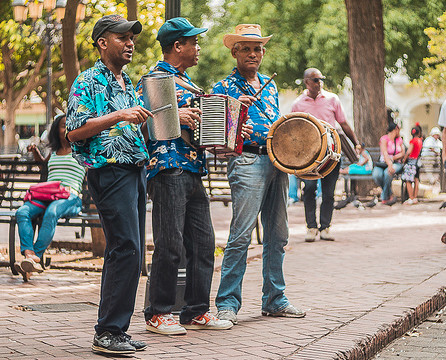
At first, merengue típico cibaeño (traditional Cibaoan merengue) was played on stringed instruments like the tres and cuatro, but when Germans came to the island in the late 19th century trading their instruments for tobacco, the accordion quickly replaced the strings as lead instrument. The two principal percussion instruments, güira and tambora, have been part of the ensemble since the music's inception, and are so important that they are often considered symbolic of the whole country. The güira is a metal scraper believed to be of native Taíno origin, while the tambora is a two-headed drum of African origin. Together with the European accordion, the típico group symbolizes the three cultures that combined to make today's Dominican Republic.
One important figure in early merengue was Francisco "Ñico" Lora (1880-1971), who is often credited for quickly popularizing the accordion at the turn of the 20th century. Lora was once asked how many merengues he had composed in his lifetime and he answered "thousands", probably without much exaggeration, and many of these compositions are still a standard part of the típico repertoire. He was a skilled improviser who could compose songs on the spot, by request. But he has also been likened to a journalist, since in his precomposed songs "he commented on everything with his accordion" (Pichardo, in Austerlitz 1997:35). His compositions discussed current events such as Cuban independence, World War I, the arrival of the airplane, and US occupation of the Dominican Republic. Among Lora's contemporaries are Toño Abreu and Hipólito Martínez, best remembered for their merengue "Caña Brava". This popular song was composed in 1928 or 1929 as an advertisement for the Brugal rum company, who were then selling a rum of the same name. Brugal paid Martínez $5 for his efforts.
Merengue experienced a sudden elevation of status during dictator Rafael Trujillo's reign from 1930 to 1961. Although he was from the south rather than the Cibao, he did come from a rural area and from a lower class family, so he decided that the rural style of perico ripiao should be the Dominican national symbol. Like any dictator, he was a megalomaniac who constantly required fuel for his ego, and he ordered numerous merengues to be composed in his honor. With titles like "Literacy", "Trujillo is great and immortal", and "Trujillo the great architect", these songs describe his virtues and extol his contributions to the country. Trujillo's interest in and encourangement of merengue created a place for the music on the radio and in respectable ballrooms. Musicians like Luis Alberti began to play with "big band" or orquesta instrumentation, replacing the accordion with a horn section and initiating a split between this new, mostly urban style and mostly rural perico ripiao. Today, New York City Latino radio is still dominated by orquesta merengue (covered in part II).
Típico musicians continued to innovate within their style during the latter half of the twentieth century. Tatico Henríquez (d.1976), considered the godfather of modern merengue típico, replaced the marimba with electric bass and added a saxophone (it was used before, but infrequently) to harmonize with the accordion. A prolific composer, Tatico's influence cannot be overestimated: nationally broadcast radio and television appearances brought his music to all parts of the country, leading to widespread imitation of his style and dissemination of his compositions. Today, these works form the core of any típico musician's repertoire. Other innovations from this period include the addition of the bass drum now played by the güirero with a foot pedal, a development credited to Rafael Solano. Many of today's top accordionists also began their careers during this period, including El Ciego de Nagua, Rafaelito Román, and Francisco Ulloa.
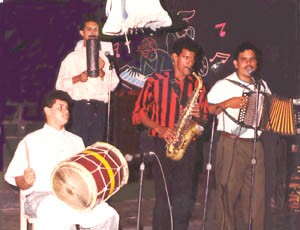
In the 1990s, most groups maintained the five-man lineup of accordion, sax, tambora, güira, and bass guitar, though a few new innovations have been made. Some younger band leaders have also added congas, timbales (played by the tamborero), and keyboards to their groups in an attempt to close the gap between típico and orquesta and increase their listening audience. The most popular artist at present is El Prodigio, a young accordionist respected by típico musicians of all ages. Though he has become famous for recording his own compositions in a modern style, he is also able to perform all the "standards" of the traditional típico repertoire and is a talented, jazzy improviser. New York-based groups like Fulanito have experimented with the fusion of típico accordion with rap vocals. Young artists such as these have been able to bring merengue típico to new audiences.
Merengue típico songs are generally composed in two parts. The first section is rhythmically straightforward and is used to introduce the song's melodic and lyrical material; here, verses are sung and the only improvisation heard occurs at the end of song lines, when the accordion or saxophone fills in. The second section is dominated by improvisation, more complex rhythms, and hard-driving mambo, or the part of the song where melody instruments (sax and accordion) unite to play catchy, syncopated riffs or jaleos which help motivate and stimulate dancers. Típico rhythms include merengue derecho, or straight-ahead merengue, which is the kind of fast-paced 2/4 time merengue most of us are used to hearing, usually used in the first section. Pambiche or merengue apambichao is similar but usually slower, and can be recognized by the double slap rhythm on the tambora. Guinchao is a third rhythm combining the first two that is commonly heard in the second section of a merengue. Típico groups do not have to limit themselves to merengue as they can also play other traditional rhythms from the Dominican Republic and elsewhere, though this was more common in the past than at present. Mangulina and guaracha are now seldom heard; the latter is a clave-based style in 4/4 originally from Cuba, while the former is a 6/8 dance native to the DR. Paseo was a slow introduction to a merengue song during which couples would promenade around the dance floor in stately fashion.


You completed a number of fine points there. I did a search on the theme and found the majority of folks will agree with your blog. eegebgcekdef
Buenas tardes.
Me siento ser una persona muy atraída por esa rica raíz cultural, como dominicano amante de mi país y nuestra nación.
Pero esos intérpretes genuinos naturales, verdaderos virtuosos del Acordeón como lo fue PEDRO REYNOSO, y su Trío quienes por vez primera exhibieron el merengue típico dominicano fuera del país, no se menciona y ni siquiera se sabe de qué? O porqué? falleció tan temprano, creo que en 1965 Pedro Reynoso muere sin rastro.
Si alguien sabe la causa de su desaparición le agradezco me lo informe, solo por interés cultural y humano. Pues a mi entender, donde se habla de merengue típico dominicano y no se hace mención del TRÍO REYNOSO original, dicha conversación o exposición no está completa.
estaba buscando tipos de merenge y no me gusto lo que encontre
Tatico Henríquez (d.1976), considerado el padrino del merengue típico moderno, reemplazó la marimba con el bajo eléctrico y añadió un saxofón (antes utilizado ocasionalmente) para armonizar con el acordeón.
Si leen bien notarán que dice que el añadió un saxofon que anteriormente se habia utilizado en ocasiones, no dice que fue el primero sino que lo añadió.
No es cierto que Tatico Henriquez introdujera el saxofón por primera vez al perico típico, en la segunda mitad del siglo xx,pues a principio de ese mismo siglo Ñico Lora tenia en su conjunto un saxo (existe una grabación de la época con el tema Hatillo Palma , y posteriormente Angel viloria,e isidoro flores también....igualmente Los hermanos Vasquez en Santiago habían introducido el jaleo de saxo por los años de 1910....o sea los aportes de Tatico son otros pero no del saxofón..OJO::::si estoy equivocado le pido excusa de lo contrario.debe de aclarar ese punto pues crea confusión cuando alguien se topa con música de Angel viloria y de Isidoro Flores con saxofón y piensa que es posterior a la aparición de Tatico siendo todo lo contrario..Gracias.
No es cierto que Tatico Henriquez introdujera el saxofón por primera vez al perico típico, en la segunda mitad del siglo xx,pues a principio de ese mismo siglo Ñico Lora tenia en su conjunto un saxo (existe una grabación de la época con el tema Hatillo Palma , y posteriormente Angel viloria,e isidoro flores también....igualmente Los hermanos Vasquez en Santiago habían introducido el jaleo de saxo por los años de 1910....o sea los aportes de Tatico son otros pero no del saxofón..OJO::::si estoy equivocado le pido excusa de lo contrario.debe de aclarar ese punto pues crea confusión cuando alguien se topa con música de Angel viloria y de Isidoro Flores con saxofón y piensa que es posterior a la aparición de Tatico siendo todo lo contrario..Gracias.
Me gusta conocer del merengue quisiera que algún experto informara sobre: Cuantas variantes tiene el merengue Dominicano y a que obedece? A)a la estructura armónica? B)o a la estructura rítmica? esa formas que llaman en algunas partes "a lo maco" por ejemplo que define?. de ante mano gracias.
Referente al legendario Tatico Henriquez, Tatico no fue el innovador" introduciendo el saxofon" Porque quien introdujo el saxfon fue Antonio Lora (saxofonista y compositor de Los algodones) quien acompañaba a su padre Francisco Ñico Lora en las fiestas y practicas de su padre, posteriomente el conjunto mas rosonado de la epoca de los 40 y 50 el gran "Conjunto Tipico cibaeño" de Angel Viloria fue quien definitivamente le da estatus tipico al saxofon con el uno de los mejores saxofonista que ha conocido el merengue tipico, el venerable "Ramon Garcia".. cuyo estilo (Tarareo) no ha podido ser imitado por ningun saxofonista en la historia del merengue, al mismo tiempo la aparicion del mas grande conjunto tipico de todos los tiempos "Trio Reynoso" hace uso del Saxafon en su plataforma y estilo. Tatico quien se da a conocer a la muerte de don Pedro Reynoso en 1965, toma el acordion que pudo "cubrir" la perdida de don Pedro, aun luego de la formacion de Tatico y sus muchachos , como lo muestra el enorme legado grabado de Tatico, la agrupacion de Tatico en su mayor parte se compuso de 5 inigualables musicos. Tambora, guira, bajo o marimba, guira y acordion, el saxofon aparece en muy pocas grabaciones con Fello Francisco, El poder de la musica de Tatico radicaba en su estilo dinamico de la costa y su formidable dominio del acordion , su jocosa voz, y la calidad de sus musicos. Ing. Francisco Martinez. Agosto 9 2016.
Me gusto mucho la respuesta
:-$
Me gusto la respuesta
SUBSCRIBE TO IASO


Add new comment